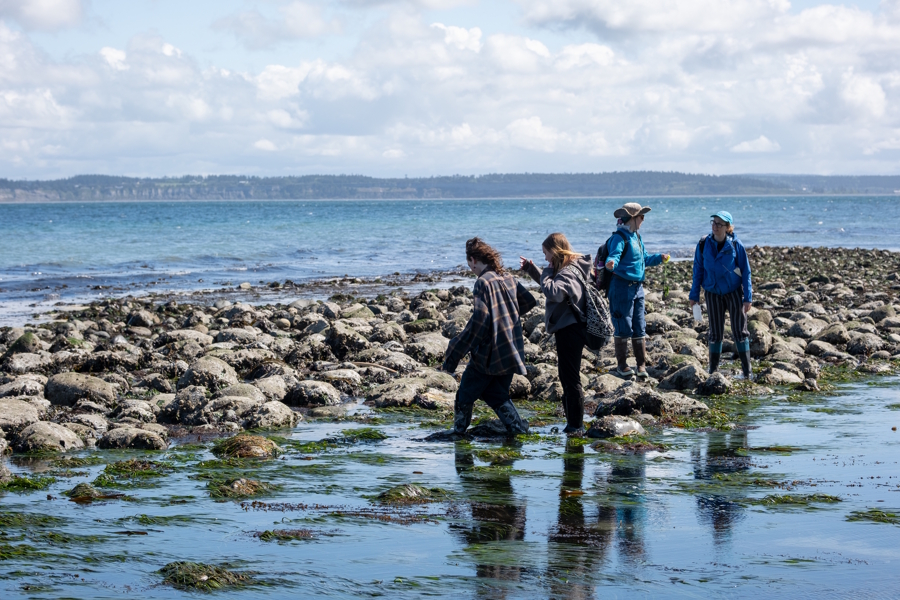
Science education increasingly asks students to engage with complex environmental systems, yet many middle school learners experience these concepts as abstract and disconnected from their everyday lives. As a result, students are often positioned as passive recipients of information rather than active participants in understanding the environments they move through daily. Existing research in place-based and experiential learning suggests that students develop deeper understanding when learning is grounded in real-world contexts and local environments. However, there is still a gap in understanding how structured, movement-based interaction can support students in interpreting and making meaning from these experiences, particularly within flexible, classroom-friendly learning tools.
Coastal Motion was developed in response to this gap, emphasizing a learning cycle of observation, documentation, reflection, and connection. Rather than beginning with explanation, the design encourages learners to first notice and interpret environmental processes in their own words before connecting those experiences to scientific concepts. The purpose of this study is to explore how a movement-based, place-based learning tool influences middle school students’ conceptual understanding of coastal systems and their engagement in environmental inquiry. Guiding this study are the following research questions: How does participation in Coastal Motion activities influence students’ understanding of coastal systems? In what ways do observation and documentation support student engagement and inquiry? How do students interpret and make meaning from their local environments through these activities?
This study will use a design-based research approach informed by the Coastal Motion conjecture map, which proposes that structured interaction with familiar environments supports deeper understanding and confidence in inquiry. This approach is informed by theories of experiential and place-based learning, which emphasize that understanding develops through interaction with real-world environments. Participants will include middle school students in coastal communities, along with educators implementing the toolkit. A mixed-methods approach will be used, combining qualitative data such as student interviews, observational field notes, and student-generated artifacts with quantitative measures such as pre- and post-assessments of conceptual understanding. Additional data may include patterns of use and educator feedback to better understand how the toolkit functions across different contexts. Ethical considerations will include informed consent, voluntary participation, and the protection of student privacy.
This study is significant because it explores how learning can be grounded in students’ lived environments rather than presented as distant or abstract concepts. By examining how movement, observation, and reflection support engagement and understanding, the research contributes to ongoing conversations in instructional design and educational technology. The findings may inform the development of flexible, context-driven learning tools that support both conceptual understanding and student ownership of learning. More broadly, this work highlights the importance of designing educational experiences that help learners interpret, question, and make meaning from the environments they encounter in their daily lives.
“Creative confidence is like a muscle—it can be strengthened and built over time.” ~Kelley & Kelley