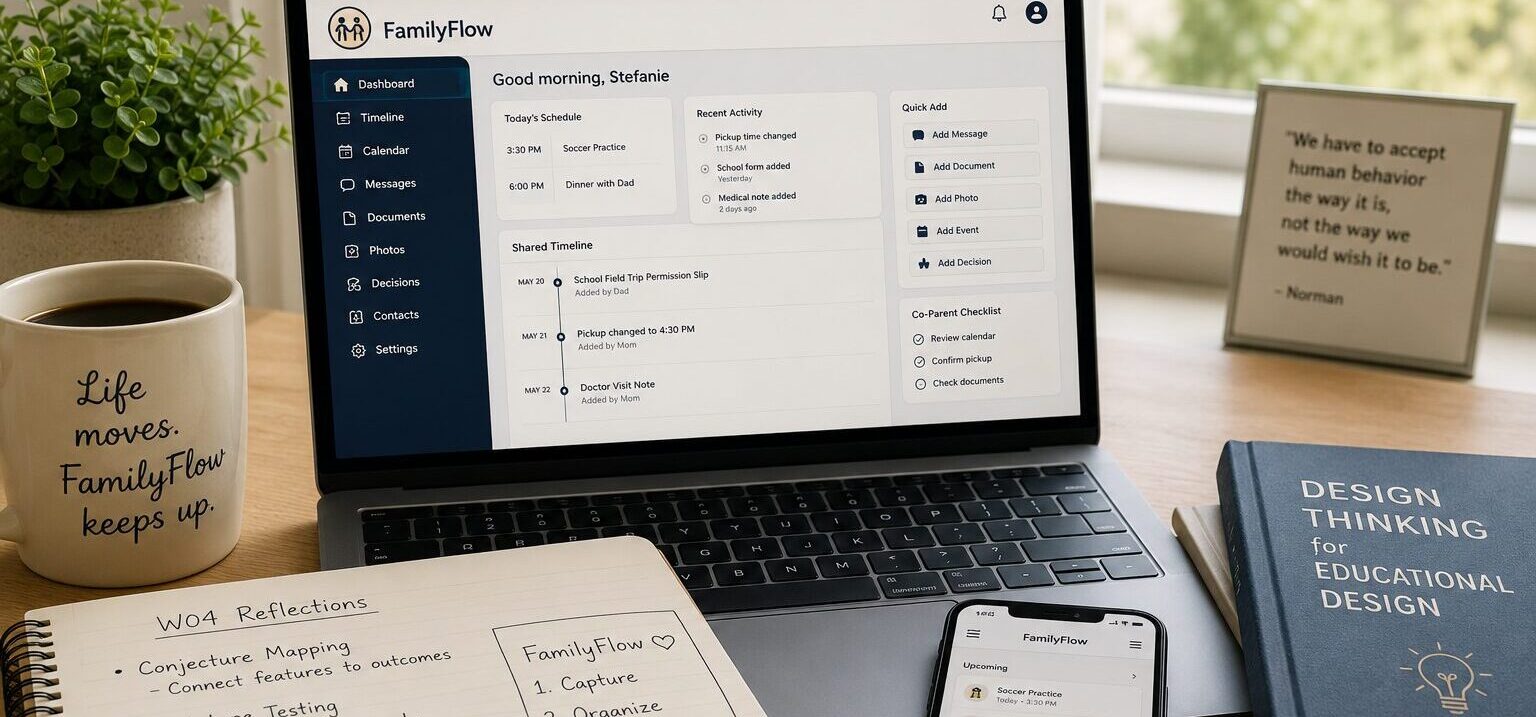
This reflection explores how conjecture mapping, meaningful learning environments, and early action can help designers test assumptions while a prototype is still developing.
Educational design research involves more than asking whether a learning environment works. It also asks how and why particular design choices shape participation, interaction, and thinking. Sandoval (2013) addresses this through conjecture mapping, a process that helps designers connect features of a learning environment to the kinds of activity and outcomes they hope to support. Wilson (2005) broadens this view by emphasizing that instructional design should create meaningful learning experiences rather than simply organized systems of content. Kelley and Kelley (2013) add another important layer by encouraging designers to move from planning into action. Their discussion of creative confidence shows that ideas become clearer when they are tested, prototyped, and put into real use. At the same time, these approaches require caution. A conjecture, prototype, or early design plan can guide development, but it can also oversimplify the people, roles, and contexts that shape how a tool is actually experienced.
Sandoval (2013) explains that conjecture mapping helps make the logic of a design visible. Instead of treating a tool, activity, or feature as automatically effective, the designer has to explain how it is expected to support learning or interaction. This includes identifying design features, the processes they are meant to encourage, and the outcomes they are expected to produce. Wilson (2005) supports this broader view by reminding designers to pay attention to the overall learning environment, including engagement, interaction, and the experience’s overall feel. These ideas shift design away from isolated features and toward the relationships between people, tools, tasks, and context. A design may look organized on the surface, but the more important question is whether its parts work together to support meaningful action.
Kelley and Kelley (2013) closely align with this idea by focusing on the transition from planning to action. A prototype does not need to be perfect to be valuable. Its purpose is to help the designer learn what works, what does not, and what assumptions need to be revised. This matters because planning alone can make an idea feel clearer than it really is. Once a design is sketched, tested, or used in a rough form, problems become easier to see. The designer can notice where users hesitate, where a process feels unclear, or where the intended outcome does not match the actual experience. In this way, action becomes part of the research process. Prototypes, feedback, and revision help turn design ideas into something that can be examined and improved.
As I continue developing FamilyFlow, these readings help me think more carefully about the relationship between the prototype’s features and the experience they are meant to support. The high-level conjecture behind FamilyFlow is that if co-parents can capture important information from the tools they already use, organize it into a shared timeline, and access it later through trusted records, then everyday coordination may become clearer and less dependent on memory, scattered messages, or informal reminders. However, this conjecture also raises important questions about privacy, consent, access, and trust. A parent, attorney, school, mediator, or court would not need the same view or level of control. For that reason, the next stage of FamilyFlow cannot focus only on building more screens. It has to test whether the design actually supports the clarity, confidence, and responsible documentation it is intended to foster.
“Almost every annoyance, every point of friction, hides a design opportunity.” ~ Kelley & Kelley

References:
Kelley, T., & Kelley, D. (2013). Creative confidence: Unleashing the creative potential within us all. Currency.
Sandoval, W. A. (2013). Conjecture mapping: An approach to systematic educational design research. The Journal of the Learning Sciences, 22(1), 18–36.
Wilson, B. G. (2005). Broadening our foundation for instructional design: Four pillars of practice. Educational Technology, 45(2), 10–15.